SATB stands for soprano, alto, tenor and bass, the four parts of a mixed choir from highest to lowest. Four-part harmony is music written for those four voices, and it follows a small set of voice-leading rules: keep each part in its range, keep the upper voices close together, double the right note of each chord, move each voice as little as possible, and avoid parallel fifths and octaves. Hymns, chorales and most harmony exercises are written this way.
The four parts and their ranges
| Part | Usual range | Written on |
|---|---|---|
| Soprano | C4 to G5 | Treble staff, stems up |
| Alto | G3 to C5 | Treble staff, stems down |
| Tenor | C3 to G4 | Bass staff, stems up |
| Bass | E2 to C4 | Bass staff, stems down |
These are the ranges most harmony textbooks use for exercises; real choral parts stretch a little further. C4 is middle C. For the full spread of voice types, including mezzo-soprano and baritone, see the voice types chart. If you are not sure which part you sing, start with soprano or alto, tenor or baritone?.
On a closed score the four parts share two staves, as in the table. On an open score each part gets its own staff, and the tenor is written in treble clef with a small 8 under it, meaning it sounds an octave lower.
The rules of four-part writing
Spacing
Keep no more than an octave between soprano and alto, and no more than an octave between alto and tenor. The gap between tenor and bass can be wider, because low notes close together sound muddy. Chords spaced this way sound balanced in a real choir.
No crossing
Each voice stays in its own lane: the alto never goes above the soprano, the tenor never above the alto. A voice also should not jump past the note the neighbouring voice just sang, which is called overlapping.
Doubling
A triad has three notes and you have four voices, so one note appears twice. In a root-position major or minor chord, double the root. Never double the leading tone (the seventh note of the scale, B in C major): it wants to rise to the tonic, and two voices rising to the same note make parallel octaves.
Smooth inner voices
When two chords share a note, keep it in the same voice. Move the other upper voices to the nearest note of the next chord, by step if possible. The bass is the exception; it often leaps by a fourth or fifth from root to root.
No parallel fifths or octaves
If two voices are a perfect fifth apart and both move in the same direction to another perfect fifth, those are parallel fifths. The same goes for octaves and unisons. The two lines fuse and the texture drops from four voices to three. The easiest fix is contrary motion: when the bass goes up, move the upper voices down.
Resolve the leading tone
In a V chord going to I, the leading tone moves up a half step to the tonic, at least when it is in the soprano.
A worked example: I, IV, V, I in C major
| Voice | I (C) | IV (F) | V (G) | I (C) |
|---|---|---|---|---|
| Soprano | G4 | A4 | G4 | G4 |
| Alto | E4 | F4 | D4 | E4 |
| Tenor | C4 | C4 | B3 | C4 |
| Bass | C3 | F3 | G3 | C3 |
Check it against the rules. The C in the tenor is shared by the first two chords, so it stays put. From IV to V the bass rises a step, and every upper voice moves down; had they all risen with the bass, tenor and bass would have moved from a fifth (F3 and C4) to another fifth (G3 and D4), a textbook parallel. In the V chord the leading tone B3 sits in the tenor and rises to C4 in the last chord. Each chord doubles its root, and no gap between the upper voices is wider than an octave.
Play it on a piano, or sing it with three friends.
From two voices to four
If four parts feel like a lot, start with two: a melody and one harmony line a third or a sixth below it, moving in the same direction most of the time. Thirds and sixths can run in parallel all day without breaking any rule. Add a bass on the chord roots, and you have three of the four parts. Our guide to writing a melody for your lyrics covers how to pick those chords.
Hear your parts sung
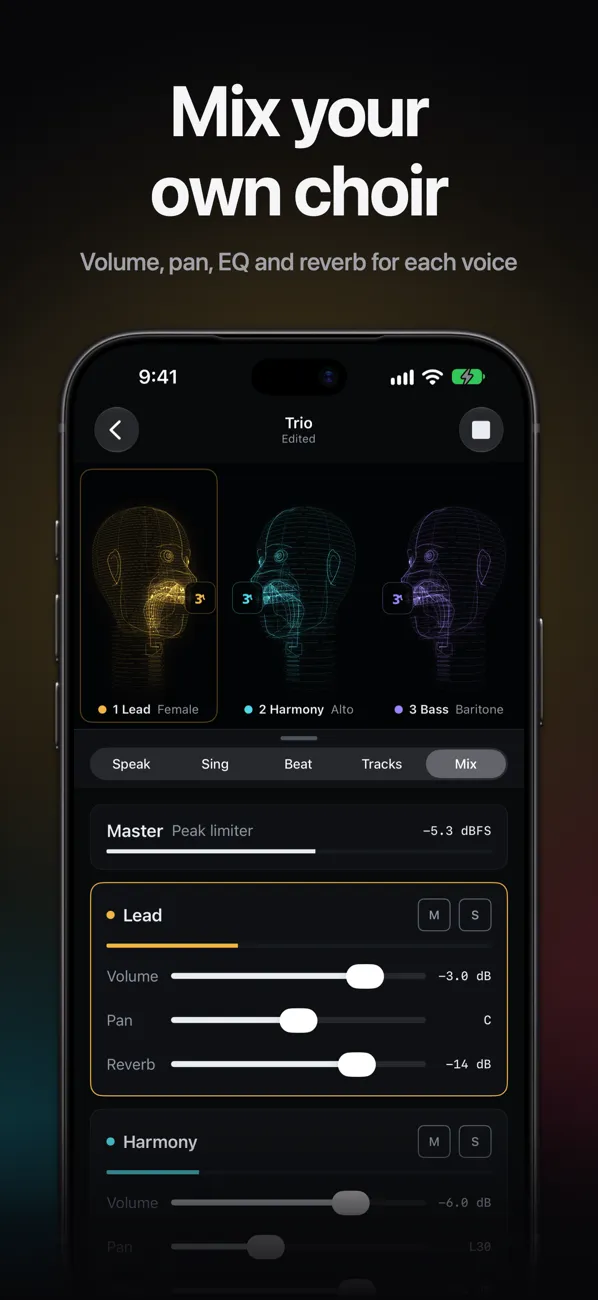
Writing harmony is easier when you can hear each line on its own. In the Glottal app every voice in a project gets its own 3D head and its own channel in the mixer, with volume, pan, EQ and reverb, so you can solo the alto or pan the tenor. You write the notes on a piano roll and set pitch, vibrato and breath note by note. The free version has two voices per project, which is enough for a melody and a harmony line; four-part SATB needs Glottal Pro, which allows up to eight voices.
When Glottal’s Make a song builds a backing for a melody, it does a simple version of the rules above: it picks one chord per bar from the key, favouring I, IV and V, and moves each backing voice to the nearest note of the next chord, so the lines move as little as they can.