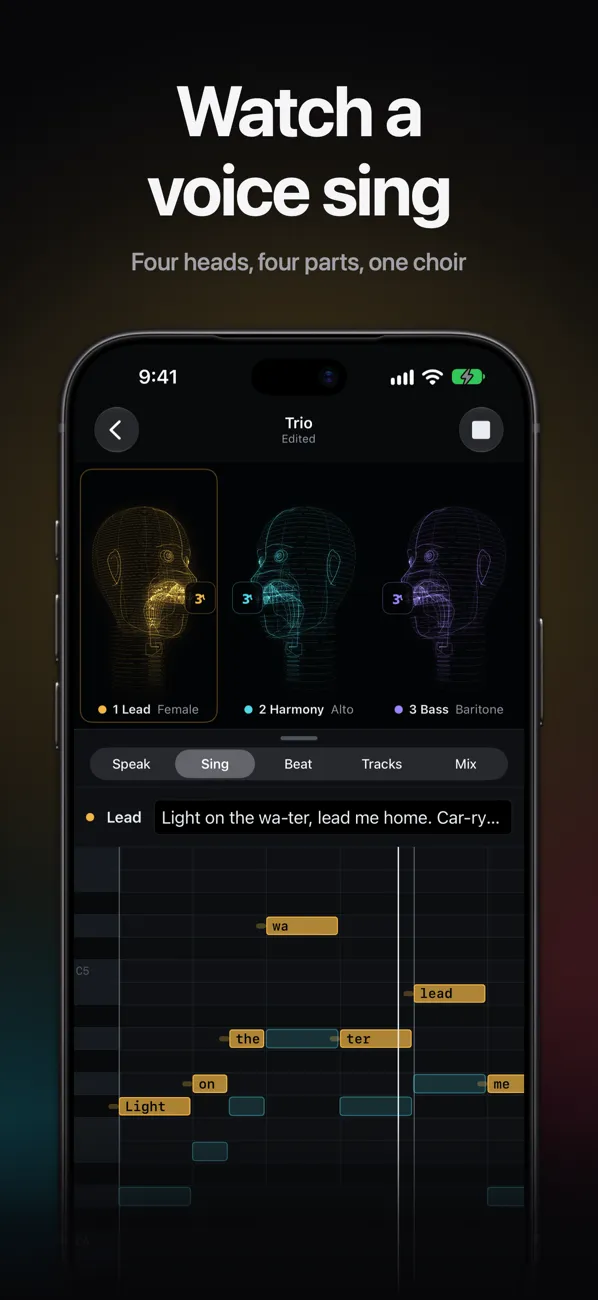
To write a melody for lyrics you already have, start from how the words sound when you speak them. Mark the stressed syllables, put them on strong beats, choose a rhythm you can repeat, give each line a shape that rises to its key word, and end the lines on notes that call and answer. The steps below take one verse from words to a tune you can sing.
1. Speak the lines and mark the stress
Read the first line out loud, at the speed you would say it to a friend. Underline the syllables that get the weight:
I walked the long way home tonight
Every language has this rhythm built in. A melody that follows it sounds natural; one that fights it sounds like a translation. Songwriters call the fit between words and music prosody.
Watch out for two-syllable words. Be-CAUSE, TO-day and a-LONE each have one strong syllable, and putting the wrong one on a strong beat is the most common reason a sung line sounds off.
2. Put the strong syllables on strong beats
In 4/4 time, beats 1 and 3 are strong and beats 2 and 4 are weak. Line the underlined syllables up with 1 and 3, and fit the rest between them. Count the syllables in each line; if one line has three more than its partner, either trim words or let the extra syllables share a beat as quicker notes.
A line does not have to start on beat 1. Starting on an unstressed pick-up, as in to-NIGHT, is called an anacrusis and is very common.
3. Pick a rhythm and repeat it
A repeated rhythm makes a melody easy to remember. Choose a short pattern of long and short notes and reuse it for every line, holding the last syllable of each line longer. Some patterns and the feel they give:
| Feel | Meter and tempo | Syllable rhythm (in beats) |
|---|---|---|
| Pop | 4/4, about 104 BPM | 1, ½, ½, 1, 1 |
| Ballad | 4/4, about 72 BPM | 1½, ½, 1, 1 |
| Lullaby | 3/4, about 84 BPM | 2, 1 |
| Waltz | 3/4, about 132 BPM | 1, 1, 1 |
| Rap | 4/4, about 92 BPM | ½ (even eighths) |
| Dance | 4/4, about 124 BPM | ½, ½, ½, ½, 1 |
These are the patterns the Glottal app uses for its Make a song styles. They are starting points; change any note that crushes a word.
4. Give each line a shape
Speech rises towards the important word and falls at the end of a sentence. A melody line can do the same. Start low, climb by step towards the word that matters, and come down at the end of the line. Mostly move by step to the next note of the scale, and save a leap for the word you want to stand out.
Keep a verse within about an octave so most voices can sing it. If you want a chorus to feel bigger, let it climb a few notes higher than the verse. Not sure what your own comfortable notes are? Our vocal range test finds them in a couple of minutes.
5. End each line on a note that answers
Number the notes of the major scale 1 to 7: do, re, mi, fa, sol, la, ti. Where a line ends changes how it feels:
- Ending on 5 (sol) or 2 (re) sounds unfinished. The listener expects more.
- Ending on 3 (mi) sounds settled but not final.
- Ending on 1 (do) sounds like home.
So a four-line verse can end its lines on 5, 2, 3 and 1. The first two lines ask, the third nearly settles, the last one lands. This is the plan Glottal’s Make a song uses to compose a melody: each line starts on a bar, rises and falls on the scale, and the last line of the song always ends on do.
6. Add chords under it
You do not need chords to write a melody, but they help you hear it. For each bar, find the chord whose notes your melody spends most time on. In C major, the three chords that cover most melodies are C (C E G), F (F A C) and G (G B D), the I, IV and V chords. End the song on the I chord.
If you later want to harmonise the tune with several voices, our guide to SATB and four-part harmony covers how the parts move.
7. Sing it, record it, fix the words that trip
Sing the verse into your phone’s voice memo. Listen back once without the lyric sheet. Every place where you stumble or a word sounds strange is either a stress on a weak beat or too many syllables in too little time. Move the note, change the word, or split a long note into two.
Hear it before you sing it
On the singing head on this site you can type your lines, pick a mood and hear a voice sing them, which is a quick way to check whether the stress falls right. The Glottal app goes further: in Make a song you type a few lines and pick one of ten styles, or hum the tune and it finds the notes for your words. It writes the melody in the style’s rhythm and, depending on the style, adds backing voices that hold the chords, a bass voice and a beat. Every note stays editable on the piano roll.