The IPA vowel chart is a map of the inside of your mouth. Up and down is how high the tongue is, which phoneticians call height. Left to right is how far forward the tongue is pushed, called backness: front vowels sit on the left, back vowels on the right. Where two symbols share a dot, the right-hand one is said with rounded lips. Those three choices, height, backness and rounding, describe almost every vowel in every language.
The official chart is published by the International Phonetic Association. Keep it open beside this page.
The two axes
Height has four labelled levels, from top to bottom:
- Close: the tongue is as high as it gets without making noise against the roof of the mouth. [i] as in see, [u] as in too.
- Close-mid: a little lower. [e] and [o], the vowels of Spanish peso and como.
- Open-mid: lower again. [ɛ] as in bed, [ɔ] as in British thought.
- Open: the jaw drops and the tongue lies low. [a] and [ɑ], the “ah” sounds.
Between the main rows sit near-close and near-open vowels such as [ɪ] in sit and [æ] in cat. Some charts call height “close/open” and some “high/low”; they mean the same thing.
Backness has three columns: front, central and back. Say see and then too. Your tongue slides from the front of the mouth to the back, and your lips round. That is one trip from the top-left corner of the chart to the top-right.
Why the chart is a trapezoid
When the tongue is high, it can reach far forward under the hard palate. When the jaw is open and the tongue is low, it cannot go as far. So the front edge of the chart slopes inward towards the bottom. The shape is a simplification of the real space the tongue moves in, not a scale drawing.
The rounding pairs
Each dot on the chart can carry two symbols. The left one is unrounded, the right one rounded:
| Unrounded | Rounded | Where you hear the rounded one |
|---|---|---|
| [i] | [y] | German über, French tu, Turkish ü |
| [e] | [ø] | German schön, French peu, Turkish ö |
| [ɯ] | [u] | Turkish ı is [ɯ]; English too is close to [u] |
| [ɑ] | [ɒ] | British lot is [ɒ] |
You can find [y] yourself: hold a long “ee”, keep the tongue exactly where it is, and round your lips as if for “oo”. The sound that comes out is [y]. Do the reverse for [ɯ]: say “oo” and spread the lips into a smile without moving the tongue.
The vowels of English
English spelling hides its vowels, so the IPA is useful here. The table uses General American, with the British (RP) symbol where it differs.
| IPA | Example | Where it sits |
|---|---|---|
| [i] | fleece | close front |
| [ɪ] | kit | near-close, a little back from front |
| [eɪ] | face | diphthong, starts close-mid front |
| [ɛ] | dress | open-mid front |
| [æ] | trap | near-open front |
| [ɑ] | father, US lot | open back |
| [ɒ] | UK lot | open back rounded |
| [ɔ] | thought | open-mid back rounded |
| [oʊ] / [əʊ] | goat | diphthong |
| [ʊ] | foot | near-close back rounded |
| [u] | goose | close back rounded |
| [ʌ] | strut | open-mid, back to central |
| [ə] | about | mid central (schwa) |
| [ɝ] / [ɜː] | nurse | mid central, r-coloured in US English |
| [aɪ] | price | diphthong |
| [aʊ] | mouth | diphthong |
| [ɔɪ] | choice | diphthong |
Many Americans say lot and thought with the same vowel, [ɑ]. Accents differ a lot in this corner of the chart, so treat the table as a starting point.
A diphthong is a vowel that moves. On the chart it is drawn as an arrow from the starting point to the ending point: [aɪ] starts open and glides up to near-close front.
Feel the chart in your own mouth
Three short exercises make the chart physical:
- Height: say “ee” and slowly open to “ah” without stopping the sound. Your jaw drops and your tongue goes down. You have walked down the front edge of the chart.
- Backness: say “ee” and glide to “oo”. Put a finger on your lips; they round as your tongue pulls back.
- Rounding alone: hold “ee” and round your lips, then hold “oo” and spread them. Only the right-hand or left-hand symbol of a pair changes.
What the chart has to do with sound
The positions on the chart match the acoustics well. A high tongue gives a low first formant, and a front tongue gives a high second formant. Plot the first two formants of a speaker’s vowels on a graph with the axes reversed and you get a shape very close to the IPA trapezoid. Our guide on how the voice makes sound explains what formants are and where they come from.
See the tongue move
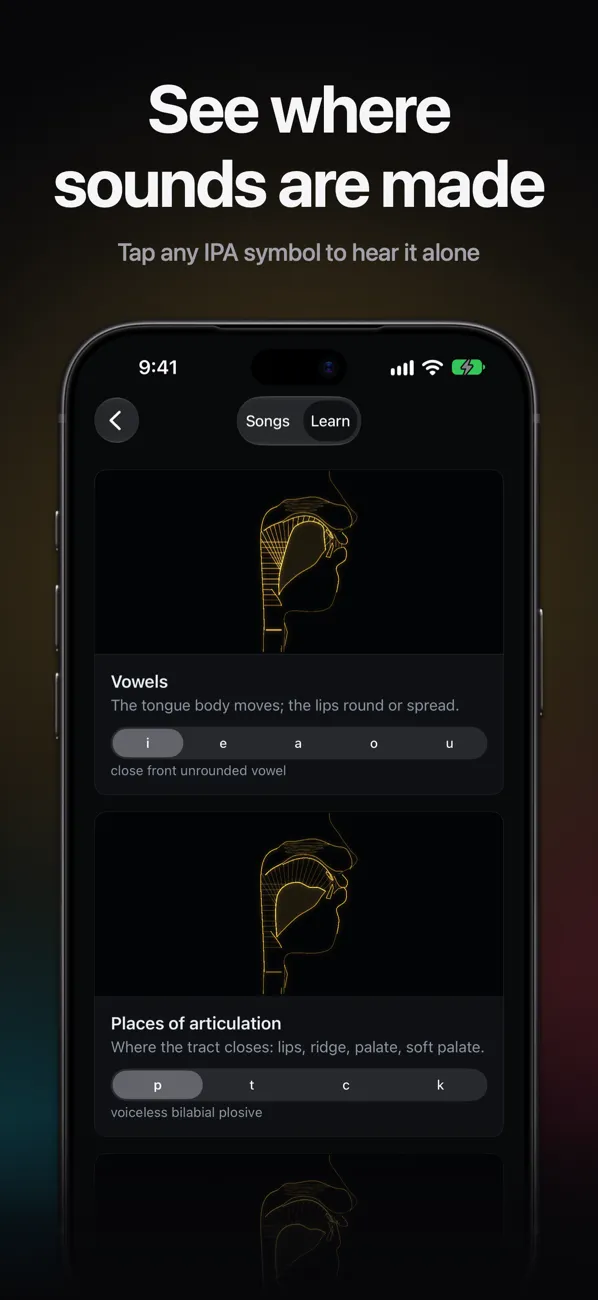
The singing head on this site is driven by a physical model of the vocal tract, and its cutaway view shows the tongue and lips while it sings. In the Glottal app the Learn tab has a vowel lesson for [i], [e], [a], [o] and [u] with a cutaway head for each one, plus lessons on Turkish sounds and nasals. Tap any symbol in the IPA guide to see where it is made and hear it on its own, or type a sentence in Speak: Glottal writes it out in IPA and lights up each sound on the tongue, lips and folds as the head says it.